On Tech

Month: December 2014

Application antipattern: Hardcoded Stub

A Hardcoded Stub constrains test determinism and execution times

When testing interactions between interdependent applications we always want to minimise the scope of the System Under Test to ensure deterministic and rapid feedback. This is often accomplished by creating a Stub of the provider application – a lightweight implementation of the provider that supplies canned API responses on demand.

For example, consider an ecommerce website with a microservice architecture. The estate includes a customer-facing Books frontend that relies upon a backend Authentication service for user access controls.
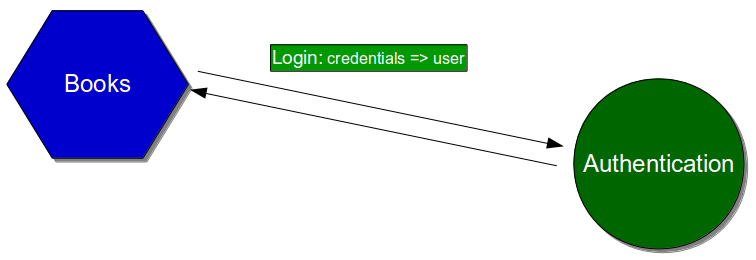
Hardcoded Stub - No Stub

As the Authentication service makes remote calls to a third party, an Authentication Stub is supplied to Books for its automated acceptance testing and manual exploratory testing.
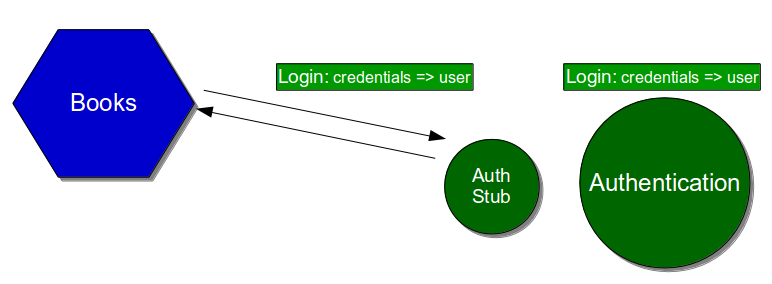
Hardcoded Stub - Stub

A common Stub implementation is a Hardcoded Stub, in which provider behaviour is defined at build time and controlled at run time by magic inputs. For the Authentication Stub that would mean a static pool of pre-authenticated users [1], accessed by magic username via the standard Authentication API [2].
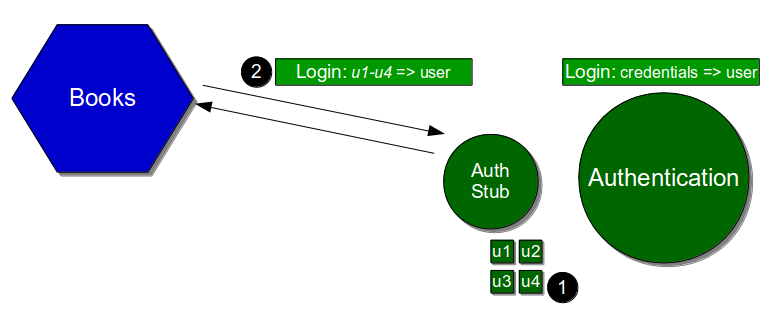
Hardcoded Stub - Hardcoded Stub Single Consumer

While the Authentication Stub has the advantage of not requiring any test setup, the implicit Books dependence upon pre-defined Authentication behaviours will impair Books test determinism and execution times:

  • Changes in the Authentication Stub can cause one to many Books tests to fail unexpectedly, increasing rework
  • Adding/removing/updating Authentication behaviours requires a new Authentication Stub release, increasing feedback loops
  • Concurrent test scenarios are constrained by the size of the Authentication Stub user pool, increasing test execution times

An inability to perform concurrent testing will have a significant impact upon lead times – parallel acceptance tests reduce build times, and parallel exploratory tests speed up tester feedback. This problem is exacerbated when multiple consumers rely on the same Hardcoded Stub, such as a Music frontend tested against the same Authentication Stub as the Books frontend. The same pool of pre-authenticated users [1] is offered to both consumers [2 and 3]
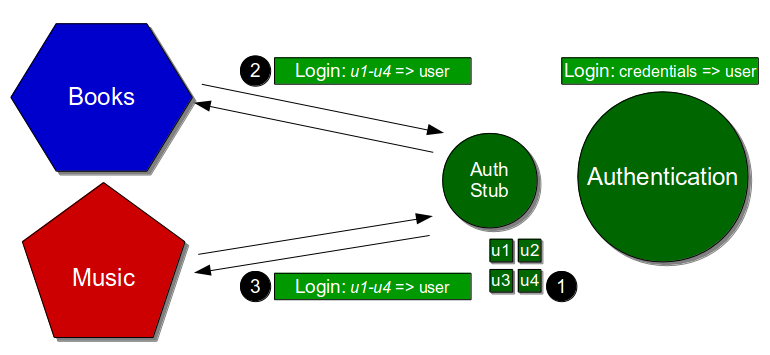
Hardcoded Stub - Hardcoded Stub Multiple Consumers

In this situation the simultaneous testing of Books and Music is bottlenecked by the pre-defined capacity of the Authentication Stub, despite their real-world independence. Test data management becomes a key issue, as testers will have to manually coordinate their use of the pre-authenticated users. A Books test could easily impact a Music test or vice versa – for example, a Books tester could accidentally lock out a user about to used by Music. Such problems can easily lead to wait times within the value stream and inflated lead times.

The root cause of these problems is the overly-contextual nature of a Hardcoded Stub. Rather than predicting test scenarios upfront and providing tightly controlled pathways through provider behaviours, a better approach is to use a Configurable Test Stub – a Configurable Test Double primed by different automated tests and/or exploratory testers to compose provider behaviours. This would mean an Authentication Stub with a private, test-only API able to create users in a desired authentication state and return their generated credentials [1a and 2a] before the standard Authenticatino API is used [1b and 2b].
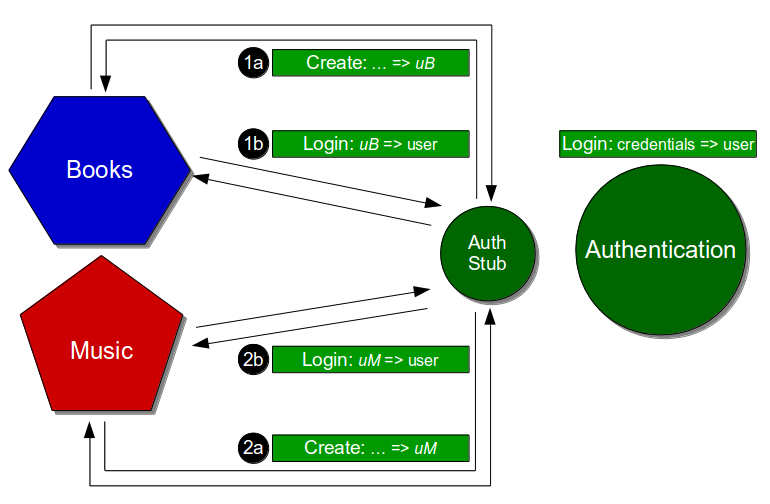
Hardcoded Stub - Configurable Stub Multiple Consumers

By pushing responsibility for Authentication behaviours onto Books and Music, test data management is decentralised and tests become atomic. The Authentication Stub will have a much lower rate of change, Consumer Driven Contracts can be used to safeguard conversation integrity, and both Books and Music can parallelise their test suites to substantially reduce execution times.

A Hardcoded Stub may be an acceptable starting point for testing consumer/provider interactions, but it is unwieldy with a large test suite and unscalable with multiple consumers. A Configurable Test Stub will prevent nondeterministic test results from creeping into consumers and ensure fast feedback.
Organisation antipattern: Passive Disaster Recovery

Passive Disaster Recovery is Risk Management Theatre

When an IT organisation is vulnerable to a negative Black Swan – an extremely low probability, extremely high cost event causing ruinous financial loss – a traditional countermeasure to minimise downtime and opportunity costs is Passive Disaster Recovery. This is where a secondary production environment is established in a separate geographic location to the primary production environment, with every product increment released into Production and Disaster Recovery retained in a cold standby state.

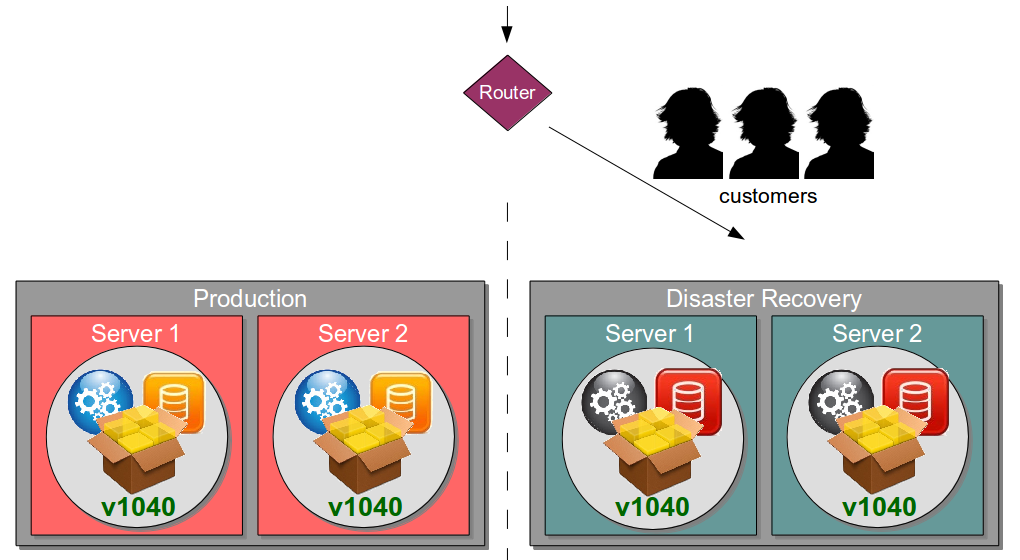
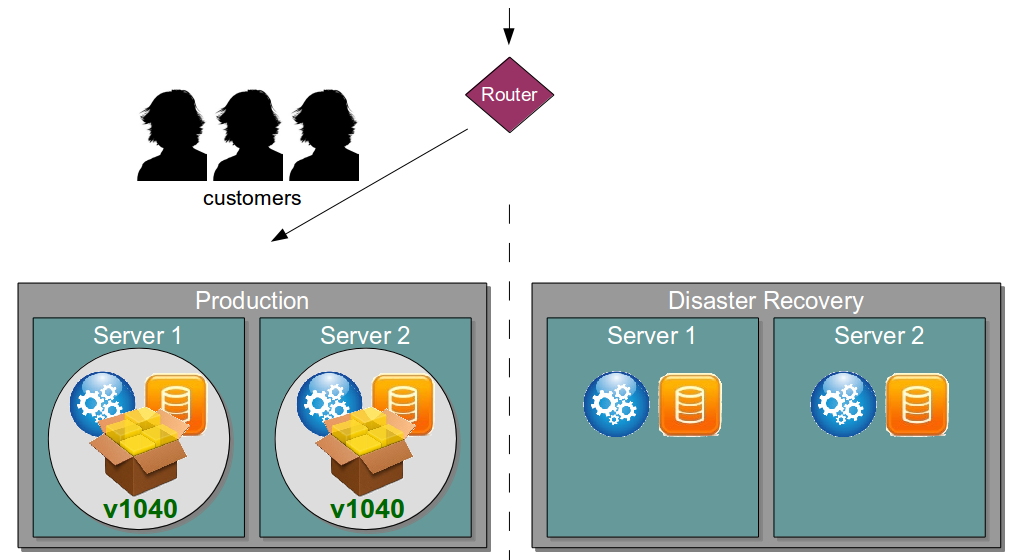
For example, consider an organisation hosting version v1040 of a customer-facing service in its Production environment. In the event of a catastrophic failure, customers should be immediately routed to the Disaster Recovery environment and receive the same quality of service.

Organisation Antipattern - Disaster Recovery Environment - Vision

Regardless of physical/virtual hosting and manual/automated infrastructure provisioning, Passive Disaster Recovery is predicated upon the fundamentally flawed assumption that active and passive environments will be identical at any given point in time. Over time the unused Disaster Recovery environment will suffer from hardware, infrastructure, configuration, and software drift until it consists of Snowflake Servers that will likely require significant manual intervention if and when Disaster Recovery is activated. With negative Black Swan opportunity costs incurred at a rapid pace the entire future of the organisation might be placed in jeopardy.

Organisation Antipattern - Disaster Recovery Environment - Failover Drift

Passive Disaster Recovery remains common due to an industry-wide underestimation of negative Black Swan events. It is easier for an individual or an organisation to appreciate the extremely low probability of a disastrous business event rather than the extremely high opportunity cost, and as a result a Disaster Recovery environment tends to be procured when a business project begins and left to decay into Risk Management Theatre when the capex funding ends.

Continuous Delivery advocates a radically different approach to Disaster Recovery as it is explicitly focussed upon reducing the time, risk, and opportunity cost of delivering high quality services. One of its principles is Bring The Pain Forward – increasing the cadence of high cost, low frequency events to drive down transaction costs – and applying it to Disaster Recovery means moving from passive to active standby via Blue Green Releases and rotating production responsibility between two near-identical environments.

Organisation Antipattern - Disaster Recovery Environment - Blue Green Releases

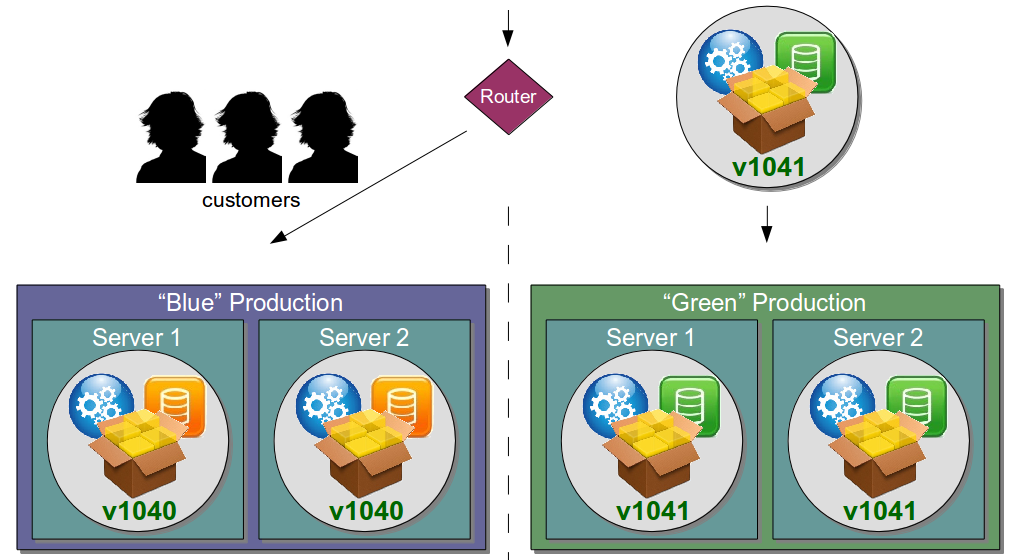
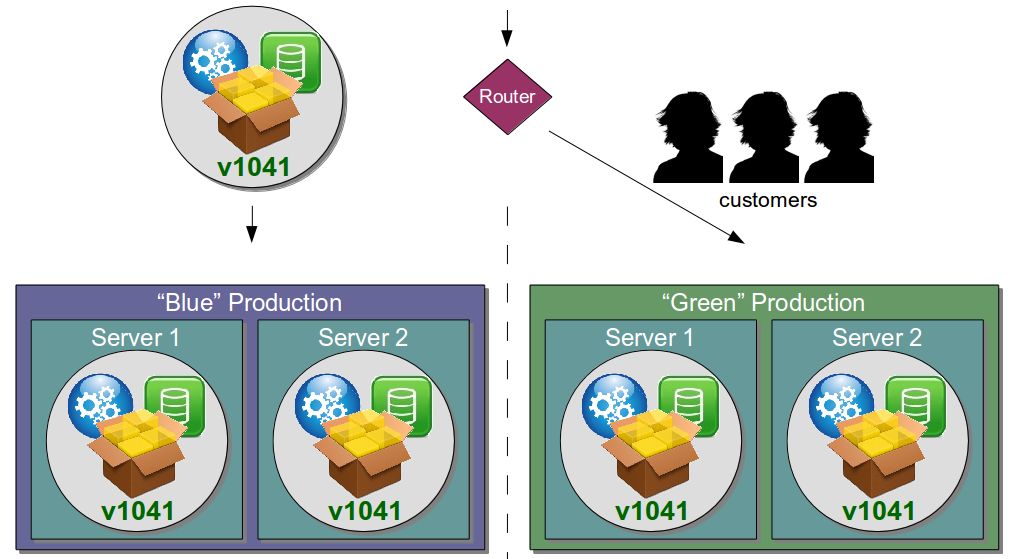
In the above diagram, the Blue production environment is currently hosting v1040 and the Green environment is being upgraded with v1041. Once v1041 passes its automated smoke tests and manual exploratory tests it is signed off and customers are seamlessly rerouted from Blue to Green. A short period of time afterwards Blue is upgraded in the background and awaits the next production release.

Organisation Antipattern - Disaster Recovery Environment - Green Blue Releases

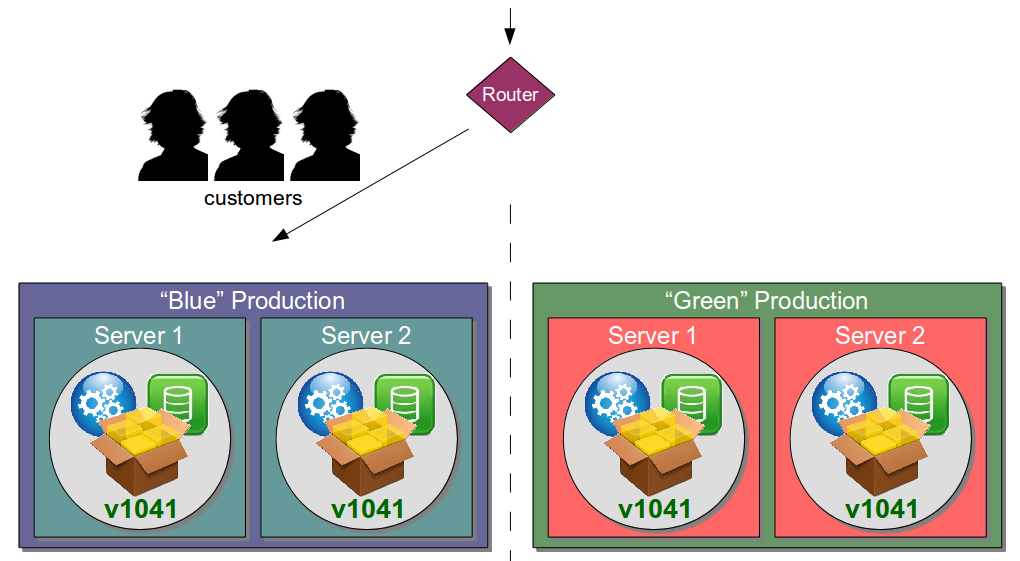
As well as enabling zero downtime releases and a cheap rollback mechanism, Blue Green Releases provides an effective Disaster Recovery strategy as the standby production environment is always active and in a known good state. If the Green environment suffers a complete outage customers can be switched to the Blue environment with complete confidence, and vice versa.

Organisation Antipattern - Disaster Recovery Environment - Blue Green Failover

By practicing Blue Green Releases an organisation is effectively rehearsing its Disaster Recovery strategy on every production release, and this can lead to advanced practices such as Chaos Engineering , Fault Injection , and Game Days. It requires a continuous investment in hardware and infrastructure, but it will reduce exposure to negative Black Swans and may even offer a strategic advantage over competitors.

© 2026 Steve Smith

Theme by Anders NorĂ©nUp ↑