Aggregate Artifacts can incrementally deliver complex applications
When pipelining inter-dependent applications, the strength of the pipeline architecture directly correlates to the assembly cost and scalability of the packaging solution. If the Uber-Artifact approach is tacitly accepted as a poor implementation choice, is there an alternative?
The inherent value of any packaging solution is the version manifest mapping of package name/version to constituent artifacts, and there is no reason why that manifest cannot be managed as an artifact itself. In terms of Domain-Driven Design a version manifest is a naturally occurring Aggregate, with the package name/version equating to an Aggregate Root and the constituent artifacts represented as Entities, suggesting a name of Aggregate Artifact.
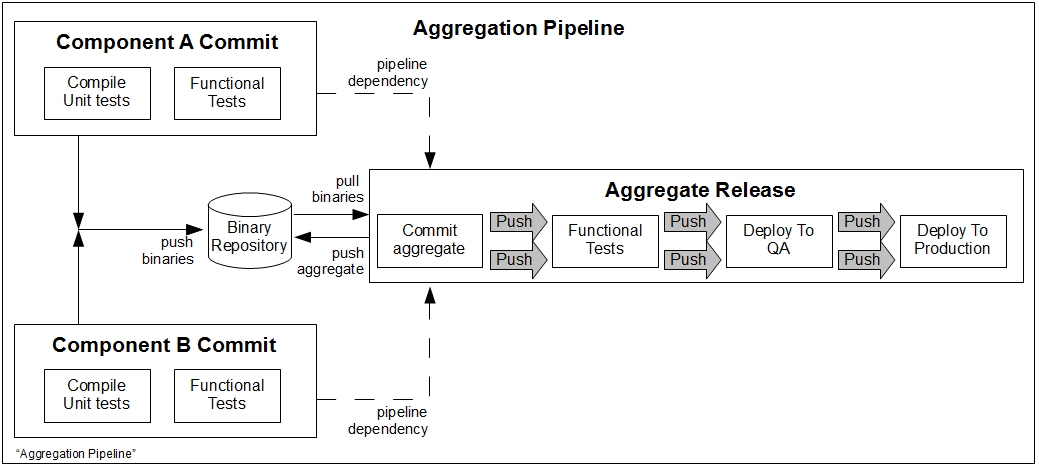
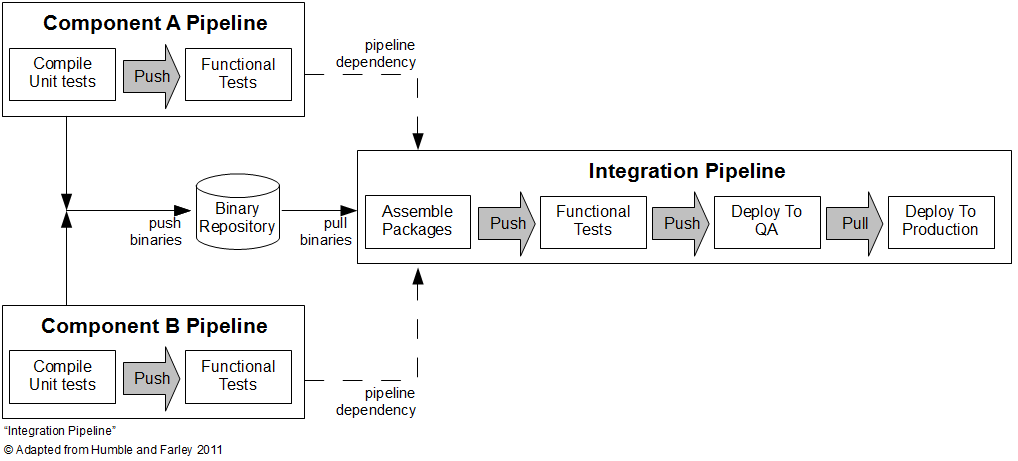
In an Aggregation Pipeline, the multiple pipelines of an Integration Pipeline are collapsed into a single pipeline with multiple commit stages. A successful commit of a constituent artifact triggers the commit of an Aggregate Artifact containing the new constituent version to the binary repository. At a later date the release stage fetches the aggregate artifact and examines the pipeline metadata for each constituent. Each constituent already known to the target environment is ignored, while the previously unknown constituents are released.
There are a number of advantages to this approach:
- Consistent release mechanism. Whether a artifact is released independently or as part of an aggregate, the same process can be used
- No duplication of artifact persistence. Committing an aggregate artifact to the binary repository does not necessitate the re-persistence of its constituents
- High version visibility. An aggregate artifact is human and machine readable and can be published in multiple formats e.g. email, PDF/HTML release notes
- Lightweight incremental release process. As an aggregate artifact is a manifest a version diff with earlier releases is easy to implement
As Aggregate Artifact persistence can be as low-tech as a properties file, the cost of the aggregate commit stage is extremely low. This means that a single Aggregate Artifact can scale to support many constituents (of which some may be Aggregate Artifacts themselves), and that failure scenarios can be easily handled.
For example, if a release of Fruit Basket 1.0 fails with the successful constituent Apples 23 and the unsuccessful constituent Oranges 49, then Stop The Line applies to Fruit Basket 1.0 and Oranges 49. Once a fix has been committed for Oranges 49, a new Fruit Basket 1.1 aggregate containing Oranges 50 and the previously successful Apples 23 can be quickly created and incrementally released to the environment.
Recent Comments