On Tech

Month: September 2013

Organisation antipattern: Project Teams

Projects kill teams and flow

Given the No Projects definition of a project as “a fixed amount of time and money assigned to deliver a large batch of value add“, it is not surprising that for many organisations a new project heralds the creation of a Project Team:

A project team is a temporary organisational unit responsible for the implementation and delivery of a project

When a new project is assigned a higher priority than business as usual and the Iron Triangle is in full effect, there can be intense pressure to deliver on time and on budget. As a result a Project Team appears to be an attractive option, as costs and progress can be monitored in isolation, and additional personnel can be diverted to the project when necessary. Unfortunately, in addition to managing the increased risk, variability, and overheads associated with a large batch of value-add, a Project Team is fatally compromised by its coupling to the project lifecycle.

The process of forming a team of complementary personnel that establish a shared culture and become highly productive is denied to Project Teams from start to finish. At the start of project implementation, the presence of a budget and a deadline means a Project Team is formed via:

  1. Cannibalisation – impairs productivity as entering team members incur a context switching overhead
  2. Recruitment – devalues cultural fit and required skills as hiring practices are compromised

Furthermore, at the end of project delivery the absence of a budget or a deadline means a Project Team is disbanded via:

  1. Cannibalisation – impairs productivity as exiting team members incur a context switching overhead
  2. Termination – devalues cultural fit and acquired skills as people are undervalued

This maximisation of resource efficiency clearly has a detrimental effect upon flow efficiency. Cannibalising a team member objectifies them as a fungible resource, and devalues their mastery of a particular domain. Project-driven recruitment of a team member ignores Johanna Rothman’s advice that “when you settle for second best, you often get third or fourth best” and “if a candidate’s cultural preferences do not match your organisation, that person will not fit“. Terminating a team member denigrates their accumulated domain knowledge and skills, and can significantly impact staff morale. Overall this strategy is predicated upon the notion that there will be no further business change, and as Allan Kelly warns that “the same people are unlikely to work together again“, it is an extremely dangerous assumption.

The inherent flaws in the Project Team model can be validated by an examination of any professional sports team that has enjoyed a period of sustained success. For example, when Sir Alex Ferguson was interviewed about his management style at Manchester United he described his initial desire to create a “continuity of supply to the first team… the players all grow up together, producing a bond“. This approach fostered a winning culture that valued long-term goals over short-term gains, and led to 20 years of unrivalled dominance. It is unlikely that Manchester United would have experienced the same amount of success had their focus been upon a particular season at the expense of others.

Therefore, the alternative to building a Project Team is to grow a Product Team:

A product team is a permanent organisational unit responsible for the continuous improvement of a product

Following Johanna’s advice to “keep teams of people together and flow the projects through cross-functional teams“, Product Teams are decoupled from project lifecycles and are empowered to pull in work as required. This enables a team to form a shared culture that reduces variability and improves stability, which as observed by Tobias Mayer “leads to enhanced focus and high performance“. Over a period of time a Product Team will master the relevant business and technical domains, which will fuel product innovation and produce a return on investment that rewards us for making the correct strategic decision of favouring products over projects.
Continuous Delivery and Cost of Delay

Use Cost of Delay to value Continuous Delivery features

When building a Continuous Delivery pipeline, we want to value and prioritise our backlog of planned features to maximise our return on investment. The time-honoured, ineffective IT approach of valuation by intuition and prioritisation by cost is particularly ill-suited to Continuous Delivery, due to its focus upon one-off infrastructure improvements to enable product flow. How can we value and prioritise our backlog of planned pipeline features to maximise economic benefits?

To value our backlog, we can calculate the Cost of Delay of each feature – its economic value over a period of time if it was immediately available. Described by Don Reinertsen as “the golden key that unlocks many doors“, Cost of Delay can be calculated by quantifying the value of change or the cost of the status quo via the following economic benefit types:

  • Increase Revenue – improve profit margin
  • Protect Revenue – sustain profit margin
  • Reduce Costs – reduce costs currently incurred
  • Avoid Costs – reduce costs potentially incurred

Cost of Delay allows us to quantify the opportunity cost between a feature being available now or later, and using money as the unit of measurement transforms stakeholder conversations from cost-cutting to delivering value. Calculation accuracy is less important than the process of collaborative information discovery, with assumptions and probabilities preferably co-owned by stakeholders and published via information radiator.

Cost of Delay = economic value over time if immediately available

To prioritise our backlog, we can use Cost of Delay Divided By Duration (CD3) – a variant of the Weighted Shortest Job First scheduling policy. With CD3 we divide Cost of Delay by duration, with a higher score resulting in a higher priority. This is an effective scheduling policy as the duration denominator promotes batch size reduction.

CD3 = Cost of Delay / Duration

As the goal of Continuous Delivery is to decrease cycle time by reducing the transaction cost of releasing software, a pipeline feature will likely yield an Avoid Cost or Reduce Cost benefit intrinsically linked to release cadence. We can therefore calculate the Cost of Delay as one of the below:

  1. Reduce Cost: Automate action(s) to decrease wait times within release processing time

    = (wait time in minutes / cycle time in days) * minute price in £

  2. Avoid Cost: Automate action(s) to decrease probability of repeating release processing time due to rework

    = (processing time in minutes / cycle time in days) * minute price in £ * % cost probability per year

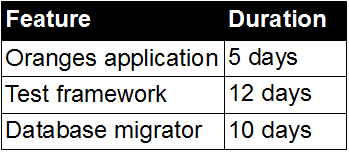
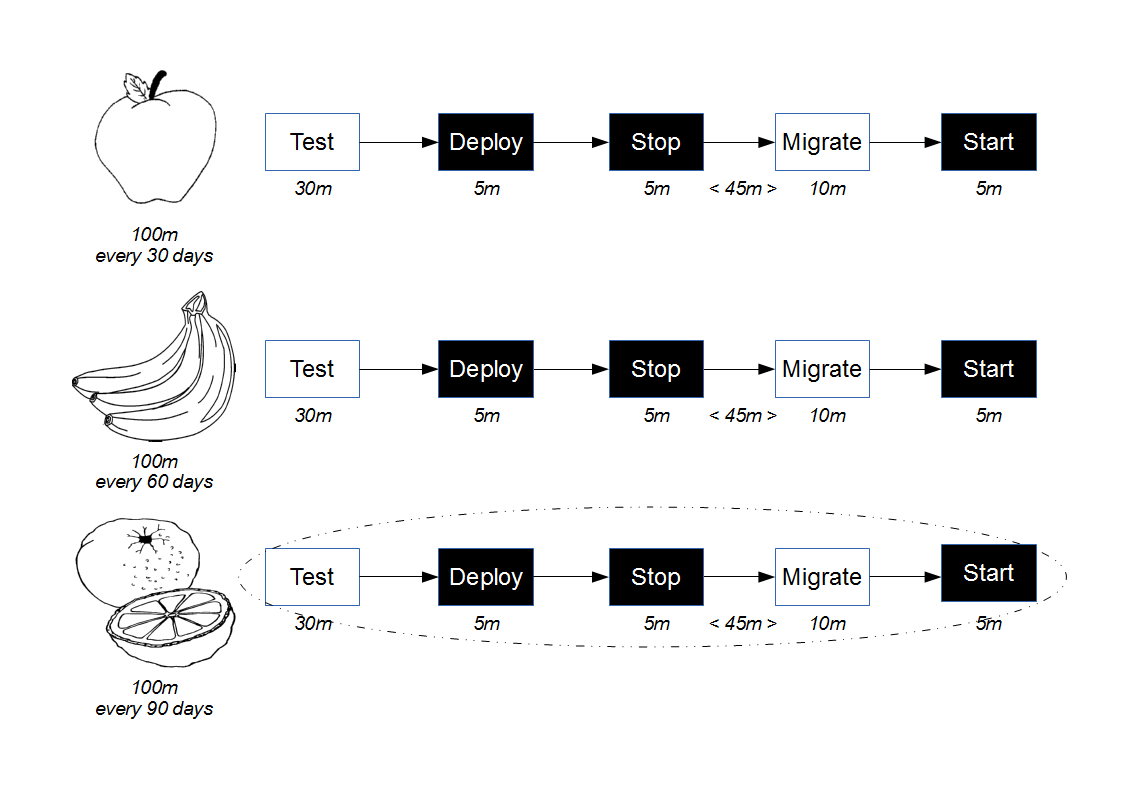
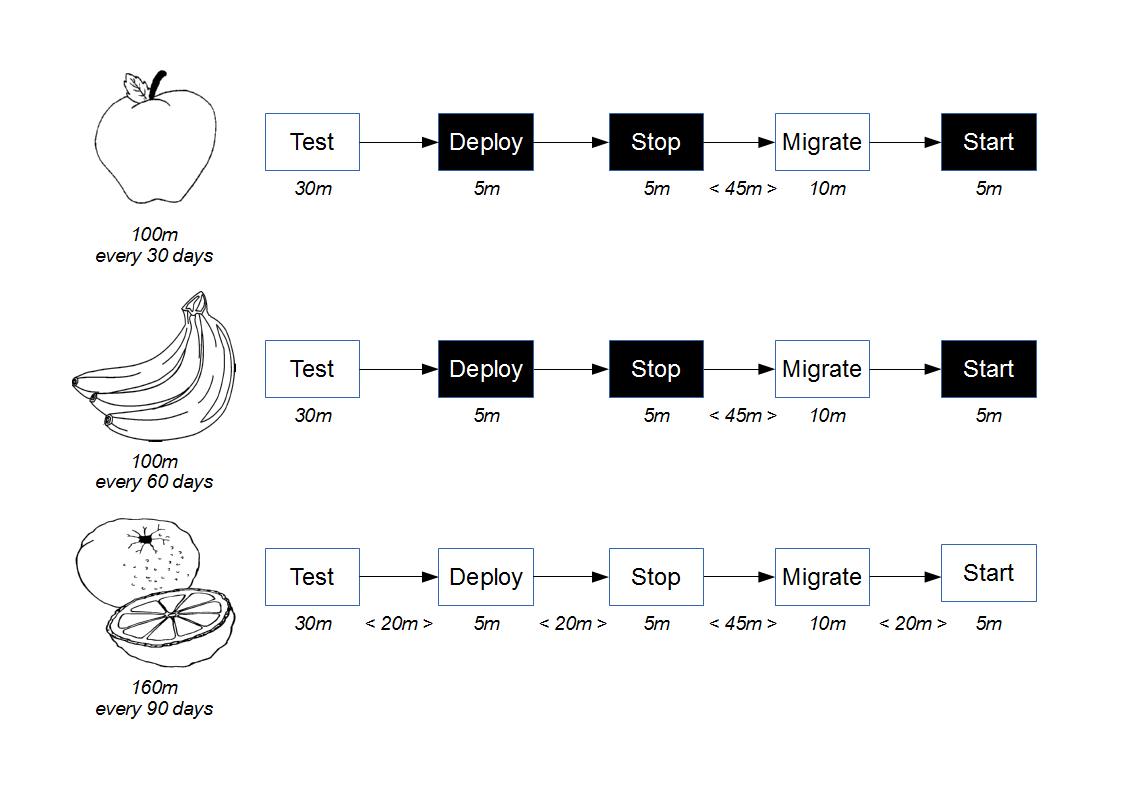
For example, consider an organisation building a Continuous Delivery pipeline to support its Apples, Bananas, and Oranges applications by fully automating its release scripts. The rate of business change is variable, with an Apples cycle time of 1 month, a Bananas cycle time of 2 months, and an Oranges cycle time of 3 months. Our pipeline has already fully automated the deploy, stop, and start actions for our Apples and Bananas applications but lacks support for our Oranges application, our test framework, and our database migrator.
Application Estate Once our development team have provided their cost estimates, how do we determine which feature to implement next without resorting to intuition?

Backlog Duration We begin by agreeing with our pipeline stakeholders an arbitrary price for a minute of our time of £10000, and calculate the Cost of Delay for supporting the Oranges application as:
Support Oranges application

= (wait time / cycle time) * minute price
= (20 + 20 + 20 / 90) * 10000
= 0.67 * 10000
= £6700 per day

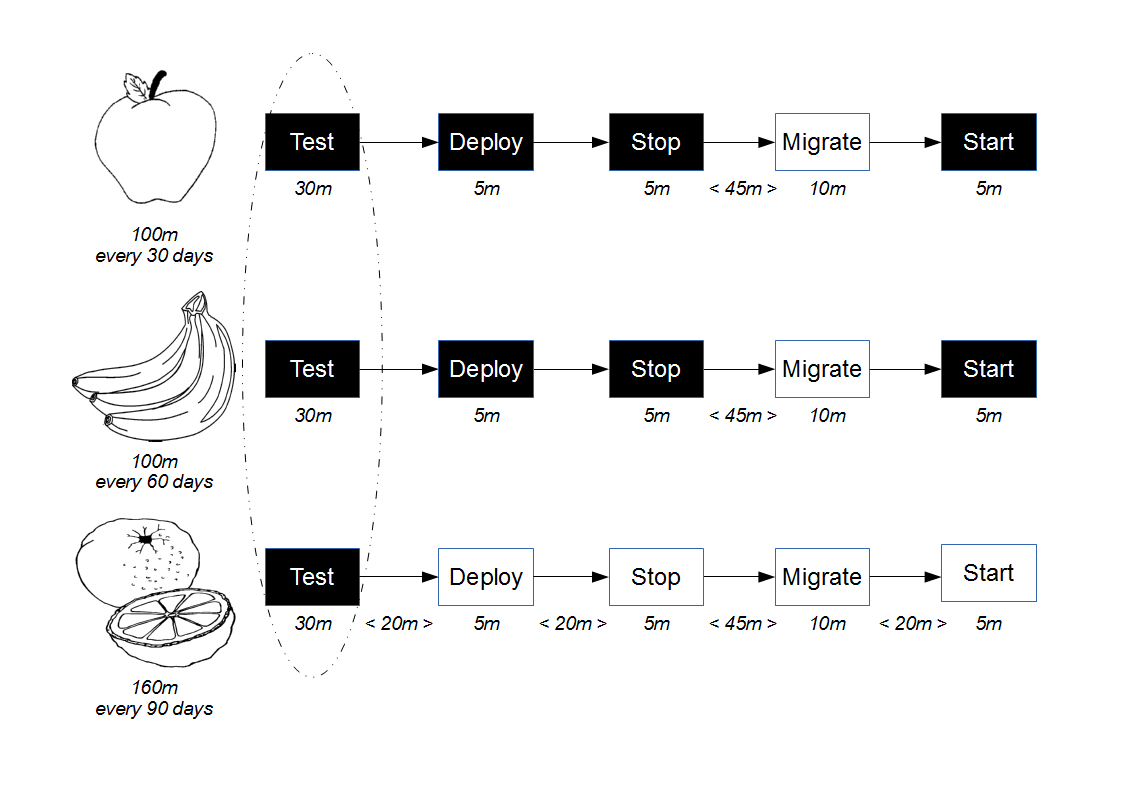
Given the test framework has failed twice in the past year and caused a repeat of release processing time specifically due to its lack of pipeline support, the Cost of Delay is:
Support test framework

= (100 / months in a year) * occurrences
= (100 / 12) * 2
= 16% cost probability per year

= (processing time / cycle time) * minute price * % cost probability
= ((100 / 30) + (100 / 60) + (160 / 90)) * 10000 * 16%
= 6.78 * 10000 * 16%
= £10848 per day (£5328 Apples, £2672 Bananas, £2848 Oranges)

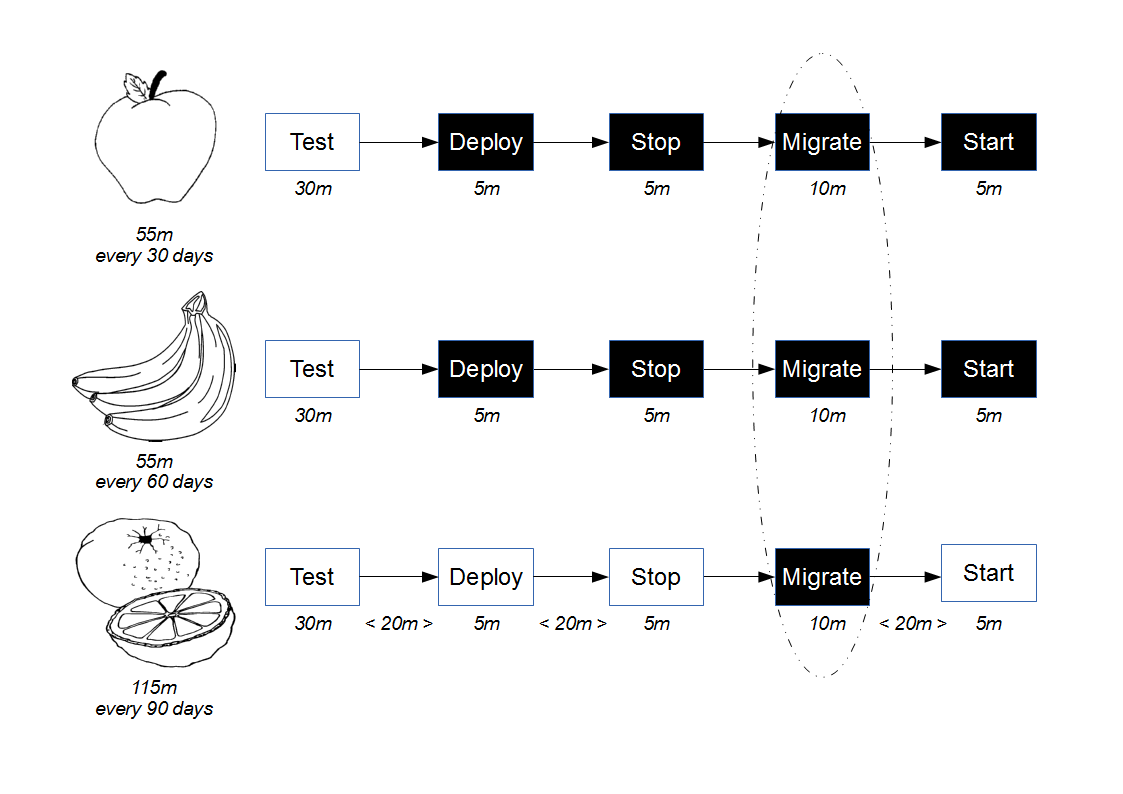
The Cost of Delay for supporting the database migrator is:

Support database migrator

= (wait time / cycle time) * minute price
= ((45 / 30) + (45 / 60) + (45 / 90)) * 10000
= 2.75 * 10000
= £27500 per day (£15000 Apples, £7500 Bananas, £5000 Oranges)

Now that we have established the value of the planned pipeline features, we can use CD3 to produce an optimal work queue. CD3 confirms that support for the database migrator is our most urgent priority:

Backlog CD3

This example shows that using Cost of Delay and CD3 within Continuous Delivery validates Mary Poppendieck’s argument that “basing development decisions on economic models helps the development team make good tradeoff decisions“. As well as learning support for the database migrator is twice as valuable as any current alternative, we can offer new options to our pipeline stakeholders – for example, if an Apples-specific database migrator required only 5 days, it would become our most desirable feature (£15000 per day / 5 days = CD3 score of 3000).

© 2026 Steve Smith

Theme by Anders NorénUp ↑