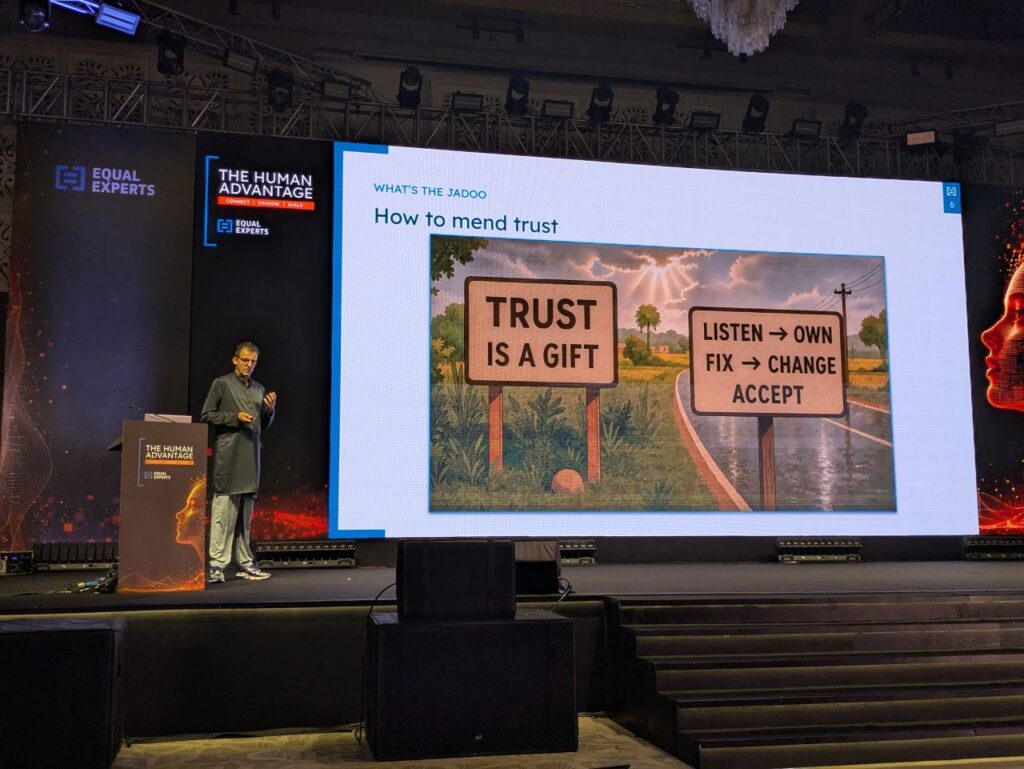
In October, I had the honour of keynoting Equal Experts India Conf 2026, for the second year in a row. Equal Experts India is 500+ employees, which is incredible given our experts-only model in which everyone has 10+ years experience. My 2026 keynote was about mending trust with people (a sequel to my 2025 keynote on creating trust), and accountability was a key topic.
I’ve said before that accountability is how organisations learn. It’s people being able to ask and answer questions. In India, I talked about a kursi, a hot seat, as a symbol for accountability. Sitting on it and helping someone to understand how you made a decision is how you learn together.
What good questions look like
The quality of questions matters. A high quality question is open-ended, respectful, and well-intentioned. It’s about your desire to learn, not your perception of someone’s actions. Ask “what am I missing?” rather than “why did you do it that way?”
You have to choose the right space as well. Hold a first conversation one to one, in private, until you’re sure the other person is comfortable talking more openly. Context might need protection, cultural differences might be a factor, and difficult things might be said.
What good answers look like
Answers are equally important. A high quality answer is direct, transparent, and genuine. It’s about answering the actual question in a way that shows your reasoning and the limits of your knowledge, not just your conclusions.
If you don’t know an answer, it isn’t good enough to say “I don’t know” and just leave it. If you made a mistake, it isn’t good enough to say “I didn’t mean it”. Unintentionality is worse than intentionality. It implies carelessness, or thoughtlessness, or laziness. Say “I don’t know, and I’ll find out” or “I got that wrong”.
Accountability is uncomfortable
I learned a lot about accountability, and leadership, when I worked for Dave Farley at LMAX. Dave created an accountability culture by asking questions about people’s choices, taking their answers seriously, encouraging people to question his own choices, and making the time to explain his thinking. It wasn’t always easy, and we all learned together.
One time, a new starter’s probation period was up, and Dave asked me and the other LMAX tech lead if they should become a full hire. The other tech lead said no. I tried to excuse myself, by saying I commuted with the person. Dave asked the other tech lead to leave the room, and said to me ‘this is the job you wanted – are they a yes or a no’. I said they’re a no, I’ll tell them today if you want.
A hot seat isn’t supposed to feel nice. If accountability feels comfortable, you’re in the wrong conversation, or you waited too long for a conversation. Uncomfortable questions and answers are how people learn, and build up trust.
Acknowledgements
I’m so grateful to everyone at Equal Experts India I spent time with, for sharing their experiences and challenging my ideas on trust, accountability, and much more. I look forward to visiting again soon!
Recent Comments